Showing posts with label solar. Show all posts

Friday, May 16, 2025

Solar update - 3 years in

How are our power bills?


Negative bills for Jan, Feb, Mar 2025

We changed from Contact to Z Electricity in June 2024. Similar pricing - still 3 hours free, from 3am to 6am, as well as half price electricity 9pm to 7am. But the main change is we've moved from a quite low but safely predictable 8c/kWh solar export price - to the rollercoaster of the wholesale spot price. That means we earn whatever the spot price is at the time and it changes every 30 minutes.  Spring solar export rates approached 0c/kWh but in summer it's been up around 20, 30 even 40c/kWh. We were often getting more for exporting solar power than we paid for importing grid power. February's bill was negative $95!

How is our Payback? How have things changed in the last 3 years?


4½ years more and the panels are paid off


There's been ups and downs, but the payoff has stayed fairly consistent at 8 years. 

Is this modelling is breaking down because of inflation? Power prices are going up, a larger power price will make it look like the panels are saving us less when they're actually saving us more, right? But turns out that's not happening after all. I looked at how our prices have changed over the years and because we've managed to juggle plans to our advantage we're actually paying roughly the same for power as we were in 2022.

In terms of how our panels are doing, we aren't seeing any degradation in the solar panels either which is great. Certainly nothing visible that we can discern from variations in weather. We'd expect this given that they have a 25 year warranty so any noticeable degradation after 3 years would be quite a worry.

Annual variation


We've had the panels long enough now to see how they perform in winter vs summer. 

2024 seems like a 'typical' year - 773kWh in January compared to just 200kWh in June. 75% less! That 25% of midsummer generation is still enough to keep our daytime power free-ish, when the heat pumps aren't warming up the place. We get a bit of power trickling in even on cloudy and rainy days. This is a good reason to over-spec your system though - how much power do you want to bring in, even in mid winter?

We bought an EV!


This will change things! In March we bought an MG ZS EV. It's got 320km of range and recharges from empty to full in about 24h on a trickle charger, and from 20% to 80% in 30 min on a fast charger. 

For instance, when Angela drove it back from Christchurch to Wellington, it needed one fast charge in Kaikoura. There are now plenty of fast chargers in NZ and it's charged up before you know it - 30 min is not quite enough time for a coffee and a muffin. 

24h on a trickle charger sounds like a long time, but it really isn't - because we don't commute in our car, it stays parked and plugged in in the garage and that basically means it's fully charged whenever you get into it. In fact because apparently it's slightly better for the car to not leave it sitting with a 100% charged battery, the issue is more managing it to not charge up fully and also to use the free power or the cheap power to charge it. None of which is actually necessary but it keeps me entertained. I'm turning into my Dad, who insisted on pushing our car around on the driveway because it was better for it than cold starting it.

Did we buy a battery yet?


Well, no. But my neighbour just told me about how prices are still trending down down down:

The lowest automotive prices are down to US $53 per kWh for a cell, and about US$75 in a vehicle battery pack. Might be an oversupply as EV sales are down in some markets

They are the later LFP chemistry which is far less fire prone

So A$1000 per kWh for Tesla Powerwalls is extreme, and other storage batteries for solar also look way overpriced.

I'm still hopeful to see 10kWh batteries available for much cheaper soon - which is all we need to capture a day's solar to use in the evening, and cheap/free overnight electricity to use in the morning. $1000 NZD, not $10,000 NZD would be a good price, and I'd be more than happy with second life batteries out of a parted-out EV. There is a bewildering array of batteries available now, this market is finally heating up like it should do.  But 50kWh of home battery storage is still a lot pricier than our MG with a 50kWh battery - and it doesn't come with a free car. That seems ludicrous.

I did some reading and seems like it's mainly because it's a niche market still. Folks ran through the inverter and installation costs (should only be a few thousand, certainly not up to the cost of a whole car!), interspersed with other folks with the expertise to build their own system, and had, for $1-2000 and showing their aliexpress receipts. 

We've just spent a week with Tim and Michelle in Townsville which was great fun - a battery is a no-brainer up there. Lots and lots of sunshine, zero and even negative solar export rates because everyone's doing it, and AC that runs all day and all night. The Aussie government is talking about subsidising batteries (as an alternative to building more power plants!) and like solar, anything the Aussies do creates a more mature market that we Kiwis can tap into.

Anyway, we are getting more than enough return selling our solar back to the grid right now. We now have backup power with the V2L cable that came with our MG - in other words, we can run our fridge and phone chargers off the car for a few days. So there is no point in spending any money on a battery. I will keep watching with interest.

Heating days


My work colleague, with a ducted heatpump system, has discovered 'heating days' as a metric of  electricity usage - especially if a big portion of your usage goes on heating.

This graph shows kWh usage of his heat pumps (the stacked bars) over the last 2 years, and the line is the “heating degree days” (HDD), which is the cumulative number of hours where Wellington was <16C.

The 'Heating Degree Days' line is, as you can see, a good predictor of actual heating energy usage. July 2024 bucks the trend as he went on holiday to Aus for 2 weeks 😊.

'Heating Degree Days' is also a good way of visualising whether efficiency gains have worked - has adding insulation or more efficient heating had an effect on your power bills when you adjust for Heating Degree Days?

https://Degreedays.net is his source, using NZWN as the weather station. Also lots of links to articles on that site to learn more.

Friday, April 14, 2023

It's been a year, how are the solar panels looking?

So we've had our solar panels for just over a year now. How has it gone? Any regrets? Would we do it again?

The graphs still look good

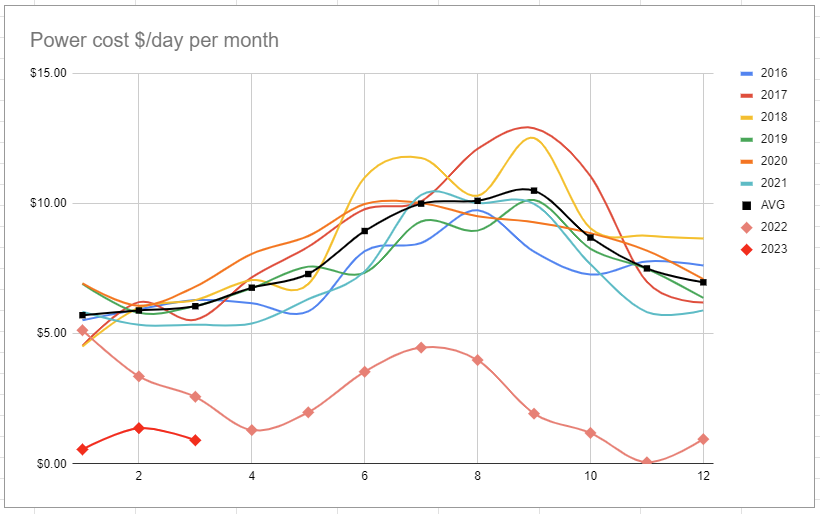
The black line is our average pre-solar power bills for the six years to 2021; the red lines are our post-solar power bills for 2022 and 2023. Solar was fitted in mid-February 2022. 

Our very best month was November when our power bill was... $1.92. Pre-solar it would have been over $230.


We've saved over $2,000 this year in power bills. That sounds like a lot, but break-even (including interest on the debt, too) is still out in 2029. That's only 8 years out of a 25 year warranty lifespan, and even 25 years later the panels should be only minimally degraded (say 10% or so).

Hot water timer - Sinotimer was the quality you'd expect for $26 ...

Much of the savings is still in making the most of Contact's free electricity from 9pm to midnight, and having the hot water cylinder come on only at this time. It keeps piping hot on that schedule no problem at all. 

A typical partly cloudy day.
Timers come on during the solar generation time
The Hot water cylinder kicks in at 9:05pm when power is free

It was all good until November when it failed. And it failed off. So no hot water for us. 

Damian the sparky came and unwired it, and we were back to switching the HWC on manually at 9pm when Alexa told us to, and off again when we blearily got up. 

... But the EuroTech timer is great

So we went to plan B which was the $218 Schneider bluetooth timer kit from Eurotech.

It's fantastic, and pays itself off in a couple of months. It works via Bluetooth off a phone app which makes setup nice and easy and I have far more confidence in getting more than just a few months out of it. You can put it onto the internet to control your HWC remotely with a 'Wiser Zwave Hub' but that's $500, so only worth it if you go all-in on home automation and put similar IoT controls on all your plugs and lights. 

The only issue was installation. The timer unit is physically quite large (deep) in ways that the hot water cylinder's external mounting box is not. After trying various ways to make it fit I settled on stacking two mounting boxes on top of each other. It actually worked tidily and well, with long screws thoroughly securing both boxes to the wall.

Anticlimactic looking for the effort that went into it

Looking for emergency power during a power cut

Oct 2023: According to everybody, if you want emergency power during a power cut you must have a battery hooked into your system. Without a battery, the solar power automatically cuts when the grid power goes down. This is because without a battery sink, the solar panels will liven the grid and make working on it highly dangerous.

However - my sister in law has just had solar installed by eSolar with a great workaround. Her system has a 'magic plug socket' that comes directly out of the inverter and bypasses the meter.

During a power cut, she can plug essential items such as her freezer and phone charger into that plug socket, and it will provide 240V and as many amps as the panels are generating. Neat!

Looking for simple static batteries

It would still be nice to have some battery storage. We usually generate far more than we can use during the day (for 8c /kWh credit) and then use power in morning and evening that we pay 30c /kWh for. It wouldn't take much storage - say 6-8 kWh - to cover off those few hours of usage and use hardly any grid electricity - apart from that free power at night that I'm so obsessed with!  

Aug 2023: there seems to be more options now. mysolarquotes have a pretty good writeup and some initial options there. The usual solar-provider suspects all seem to have smaller cheaper batteries available. I might have to revisit this, even if it's so I can write another blog post!

I am on the fence about the ROI still. An EV with vehicle-to-home capability would be ideal, because you're buying a car that happens to be a battery too, but the large outlay would probably take decades to pay off at the meagre returns you'd earn. Even with the 73% margin we pay on export vs import power, the grid is probably a better value "battery" than what we could buy.

What could change this in the future is storage batteries made from old EVs. Either modern crashed ones where the battery will effectively last forever - or old Leaf batteries that are too degraded to use in a car anymore. This degradation isn't a problem for home storage - you just get more of them! - and home use has a much lower draw and recharge rate than a car so the batteries will have a quiet retirement and should last okay.

EVs Enhanced in Christchurch operates a great "cascade" where they fit their own new batteries and high capacity used batteries to Leaf owners who want the best range they can get, then take those batteries and sell them cheap to Leaf owners with almost unuseable batteries; then what happens to the oldest batteries? They are looking for other companies to reuse them and manufacture static storage batteries. 

They pointed me at https://www.b3batteries.co.nz/ who they are talking to - they have a 'coming soon' website but let's see what happens there. I'm pretty keen for the right price.

Saturday, May 7, 2022

Solar - the first three months

We've had solar for long enough now that we can see the trends. How is it going? Is it everything we hoped and dreamed of?

The good news is - we're saving a LOT of money on our power bill.

The bad news is - we spent a LOT of money on our solar and its payback is pretty slow.

Good news

Look! The black line is our average power spend (in $/day) over the last 6 years. The red line is our spend in 2022. The solar went in in mid February.

In April we had a $40 bill instead of the usual $210 bill. That's pretty awesome.

Bad news


Adding extra Sparky work and the various timers, it's going to take us 8 years to pay off the work from that savings. That's  probably about when we will be selling the house, letting the next owner cream all the profit of our hard work.

That's just extrapolating that $170 per month savings out to the future, since we've only had one power bill with everything set up right. Who knows what will happen over winter - we need a year of data to do this properly. But then, power prices may go up, our usage may change ... it'll all be approximate at best.

It's also not like the good news graph is that robust either. Over the last 6 years we've added roof insulation, underfloor membrane barriers and some double glazing. We bought a beer fridge and changed our washer/dryer. Toby went through his teenage years and then left home. We've moved electricity providers and plans a couple of times. Oh, and there was that thing that happened that changed our habits a lot over the last two years!

But I figured that's the best I have to work with, no need to overthink it. (Um, maybe I've already overthought it.)

It's the dashboard too!

You can see the spikes where we boiled the kettle or microwaved breakfast.
And just how much usage we can shift to 9pm.

Solar or not, I reckon having direct visibility of exactly what power we're using in real time makes a huge difference. Everybody needs it! You can't budget what you can't measure. 

I'm astonished how much you can save running your high use appliances - dishwasher, washing machine, dryer - overnight on cheap power instead of say after dinner when it's convenient to just turn it on without thinking. And it's no change to the usual thing we'd do (for dishes and clothes) of turn it on, go to bed, empty it in the morning. On the other hand, modern lights use next to no power, there's no point turning them off like in the old days with 100W lightbulbs. 

You just don't know these things unless you can see what exactly what happens when you turn things on and off.

Solar Web Dashboard - translating tariff jargon

This Fronius Solar Web Dashboard also lets us estimate our costs and savings, if we enter our import and export tariffs.  The tariff names are really confusing though. Luckily I found a forum where someone had kindly translated the German English to New Zealand English:

  • Feed-in tariff (without Fronius smart meter) This is the yield of solar generation, (this is needed only if you do not have Fronius Smart Meter)
  • Reference tariff (with Fronius smart meter) This is the cost of electricity you pay to the utility in kwh, ( this is needed if you have Fronius Smart Meter)
  • Feed-in tariff (with Fronius smart meter) This is the how much utility pays to for solar going back to the grid, (this is needed if you have Fronius Smart Meter)
  • Offset [kWh] The offset Kwh allow you to add in missing kwh hours that the logger has not picked up, eg. you have inverter installed for couple of months and then you start recording the kwh. This allow you add in the total missing kwh here.
  • Offset Earning The offset earning allow you to add in missing yield that the logger has not picked up, eg. you have inverter installed for couple of months and then you start recording the yield. This allow you add in the total missing yield here.

It's the Electricity plan too!

The big red bars are FREE FREE FREE

Contact Energy's three free hours of electricity is amazing.

Between the solar during the day, and shifting all possible usage to the free power evenings, we don't have to pay for very much power at all. 

So little in fact that we've been able to move to a 'low use' plan with a base charge of 30c per day instead of $1.70 per day. Break-even is about $160 per month. We'll see how winter goes.

In a year or so we'll see if there are spot price plans that give us better export rates and maybe really cheap overnight power instead of 3 free hours. Maybe it'll be worth it.

It's the timers too!

I've also installed (or started using) all sorts of timers to restrict anything that doesn't have to run on demand, to when power is cheap.

Hot water  (3000W) - Sinotimer - 9pm to 2am

This is the big one and I've written far too much about it already. But if you don't have a timer on your electric hot water cylinder, you're spending hundreds of dollars a quarter that you don't need to.

Beer fridge (some W) - $10 Mitre 10 plug timer - 9pm to 12am, 10am to 4pm

Both Consumer NZ and my mate Gareth from EECA say that beer fridges are one of the biggest power vampires in your house. But (apart from Christmas when it's probably got turkey and ham in it) it's only got beer in it and doesn't have to run 24 hours a day.

Towel Rails (2x 100W)  - Goldair towel rail timer - 9pm to 1am, 9am to 1pm

This simple little box sits inside your plug box and turns your towel rail on for just 4 hours in 12. It's intended to get your towels warm and fluffy in the morning and evening. But I've set it to use cheap power instead. So our towels are cold and clammy, but they're dry at least.

Bathroom heated floor (some W) - Warmup W3115 timer - 9pm to 12am, 10am to 4pm 

This thermostat/timer (that came with our underfloor heating system) was a nightmare to program, I had to study the instructions in detail and write down the algorithm to program in. If it wasn't a one-off job I'd replace this thing for sure.  It's pretty old and there'll be much better ones around now.

It's also heating the floor when it's cheap, not when our delicate feet are walking over it. Oh well.

So, is it all worth it?

We went into this for largely non financial reasons, and that's lucky. Solar is going to save us money, but not for a while and if we sell our house this decade, not at all unless we recoup our investment in the sale price. 

But we're using far less power, far less dirty peak power, and we understand our usage much better. That's what we wanted and that's what we got.


Wednesday, February 23, 2022

Solar panels on the roof - the first three weeks

 As Angela's said, we now have solar panels on our roof. So how's it going after three weeks or so?

Our motivation for solar was primarily to generate watts of power that didn't need to come from Indonesian coal, shipped across the Tasman to the Huntly power station. Secondary was to save money even if it took a long payback. 

We didn't do all the research we should have to fully understand all the nuances of what we were about to do - instead we put ourselves in the hands of Harrisons Solar who had a good reputation both from the internet and word of mouth. We don't regret it, they were extremely helpful, professional, and did a really good job. 

We (well, our bank) spent $13k all up on a 12 panel, 4.7kW system. This is for a smallish 3br house with a 250L electric hot water system, nice north facing sun on an appropriately sloping roof, and 2 of us living here (though we wanted to spec the panels for the next owners too). We turned down the $18k Tesla battery. 

We also changed power suppliers to Contact Energy who currently offer free electricity between 9pm and 12am - this works really nicely so we only really draw lots of power at dawn and dusk, the rest is mostly either free or helped along by solar. We've changed our behaviour to eg only run the washing machine and dishwasher at 9pm, or in the middle of the day if we need to. I'm going to put timers on the towel rails and suchlike.

Half our panels (the western ones)

So how's it gone then? This is what we've found.

There seems to be a lot to consider in the install. You don't just throw panels on the roof and hope for the best. They're interlinked in a way that means they only give you the power of the least performing panel in the bank; you need an even number of panels in a bank; and so on.  There are a bewildering selection of inverters at very different price, functionality and quality points too.  A DIY job would take a lot of research and discussion with experts, and the right sparky to work with you, although there are also a lot of websites that do much of this work for you.  We ended up with a bank of six north-facing panels, and a 2nd bank of six west-facing panels as the best solution.  

It's kinda obvious, but if your roof is dodgy you need to replace or fix your roof before you do the solar work. You don't want to put panels up then need to take them down again to sort your roof. We replaced our roof a few years back, from the original iron the house was built with.

Solar generates steady power, but you use power in short intensive peaks. That means that without a battery, it's hard to ensure that you're using the power you make - you're either spilling to the grid or sucking from the grid for most of the time. And you pay a lot more for power you use, than they pay you for power you export.

In the following pictures, 

  • Yellow = solar power we use ourselves
  • Grey = excess solar power we export to the grid
  • Blue line = our actual consumption, when it spikes into the white area that's grid power we're using.

This is the best case - a sunny summer's day.

A more typical day with cloudy periods.

Our inverter is battery ready. I'm expecting batteries to come down in price a lot over the next few years, with increased demand, maturing tech and a heap of second life EV batteries hitting the market. Or we'll have a mobile battery with four wheels and a steering wheel in our garage in the next few years. Even a relatively small one to smooth out the peaks and troughs would be nice. Another thing is that when you sell your house you can take the battery with you no worries. Even if your next house didn't have solar you can charge it at night and use it during the day.

I was expecting to use the hot water cylinder as our battery. But, because its thermostat is either off (0W) or on (3000W) it peaks beyond what the panels can generally provide. After more research than I really wanted to do, I settled on a $26 timer fitted to the switchboard, that switches on the hot water cylinder just for three hours during the Contact Energy 'free power' evening. That's enough to provide hot water all day. I've since written a ridiculously detailed blog post about it.

I'm looking forward to my next electricity bill! I don't really know how our reduced grid usage, free night power and the (not much) money we get exporting power to the grid will all work out. I'm going to do a spreadsheet to see how our payback goes, including paying mortgage interest on the principal. I suspect not all that well. But, Indonesian coal. 

Thursday, February 3, 2022

The Wednesday that already felt like a Thursday

 Hi,

I think yesterday (Feb 2) was the last day of us checking for any symptoms from our casual contact at the airport early last week.  So - yay for KN95 masks and hunkering down at our departure gate.

And I think it is Brennan's birthday today.  Happy birthday to him.

Busy day at work - but from home.  And the way omicron is ripping through with locations of interest everywhere, it is a good thing to try and stay away from large groups of people.  Not a lockdown.  But people generally seem to be exercising some self induced versions of lockdown.  Which is all we probably need to help weather the omicron blast.  I hope.

Love bites!

Who me?

Moxley wanted attention yesterday from me.  Hahahah.  Her paws on my arm and wee bites to get my attention.  When I continued to read and ignore her, she wandered off to poke at Mike.


Resting in her pumpkin

The big news of the day was getting solar panels on the roof.  One day and the crew of 3 people came in, set up scaffolding and did the electricity meter all with no fuss and no mess.

Solar panels are on!

We're feeding into the grid - even with the grey clouds

We are now feeding into the grid.  In time for some warm, muggy wet weather for the next 3 or 4 days.

Monarch chrysalis

Mike showed me the monarch butterfly breeding programme our neighbour Juliette is doing.  Hahah.  That was fascinating.  I have never seen a chrysalis like that before.  We have about 3 on our side of the fence.

Off to bed early - really muggy, warm weather.  Yuck.  Up for online PT session.  I have a physio appointment today.  And Mike is off to the gym, irl.  Hahahah.

Quentin seems to be okay from his operation.  Still in a sling and finding it hard to get comfy sleeping.  But he will be fine, I am sure.

Take care.  Enjoy your Thursday.  Especially Brennan.

Love,
Angela